
The Third Wall
When Grandparents Become the Safety Net

This is not a new argument. It is the same one arriving at the place where every wall in this series meets: a grandmother’s kitchen table, where Social Security, Medicaid, kinship care, and grief are all expected to stretch further than they were built to go.
Part of an ongoing series, How a Nation Outsources Its Conscience.
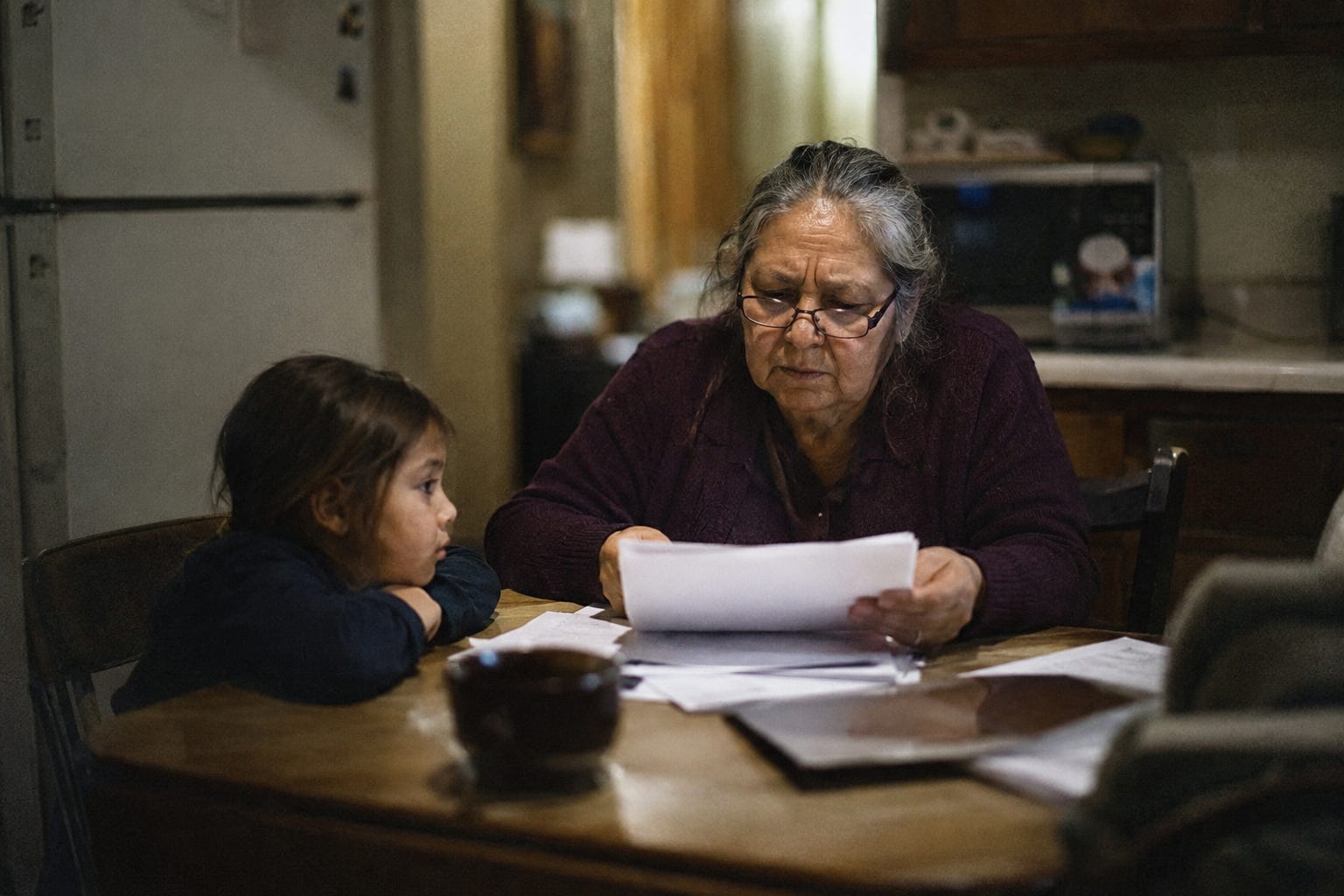
Doreen Tarrant’s daughter died of liver cancer in 2015. She left behind three children, a sixteen-year-old boy and twelve-year-old twins, and Tarrant, their grandmother, took them in.
She is sixty-one. She is not yet old enough to draw her own Social Security retirement benefit. The children draw survivor benefits instead, on their late mother’s work record, and Tarrant manages the checks as their representative payee. It helps. It stretches alongside her husband’s Navy pension. It does not make anything easy. “They have growth spurts,” she told an AARP reporter. School clothes, laundry detergent, the cost of raising three children climbing every year while the household income mostly does not. “It’s getting harder and harder,” she said.
This series has spent three installments naming the places government quietly transfers its obligations onto whoever is standing closest. A teacher buying her own supplies. A grandmother paid less than a stranger to raise the same child. A daughter providing a trillion dollars of unpaid care a year. Tarrant’s house is where those three walls meet a fourth one, the one holding up her own retirement, and start to lean on each other at once.
A retirement that was never just hers
Start with what most people do not know, because Tarrant’s own situation depends on it: Social Security was built to catch exactly this kind of household. Roughly 2.7 million minors in the United States receive Social Security benefits, more than half of them because a parent who paid into the system died, the way Tarrant’s daughter did. The program already understands that children sometimes lose the parent whose income should have supported them, and it sends a check to whoever raises that child next.
What the program understands less well is who that person usually is. More than half of grandparent caregivers are already receiving Social Security while they raise their grandchildren, often because they claimed retirement benefits early, years before full retirement age, at a permanently reduced rate, or because they are drawing disability benefits themselves. The median age at which a grandparent takes on this kind of caregiving is sixty-two. That is not a coincidence. It is the system’s quiet assumption made visible: when a family falls apart, someone old enough to already be leaning on Social Security will likely be the one who catches the children.
And the system makes catching them harder than it needs to be. The Social Security Administration estimates that only about two percent of grandchildren being raised by grandparents actually receive the child benefits they may be eligible for, in large part because claiming them often requires a grandparent to formalize legal custody or adoption, a process that costs money and time many caregivers do not have, and that some are reluctant to pursue at all, because it means closing the door on a parent who might recover. Tracy Fick, who runs kinship support services for Catholic Charities of Eastern Virginia, put it plainly: grandparents in informal arrangements are “in a very challenging position because they’re not eligible for benefits.” The lifeline exists. Most of the families who need it never reach it.
The job she cannot afford to leave
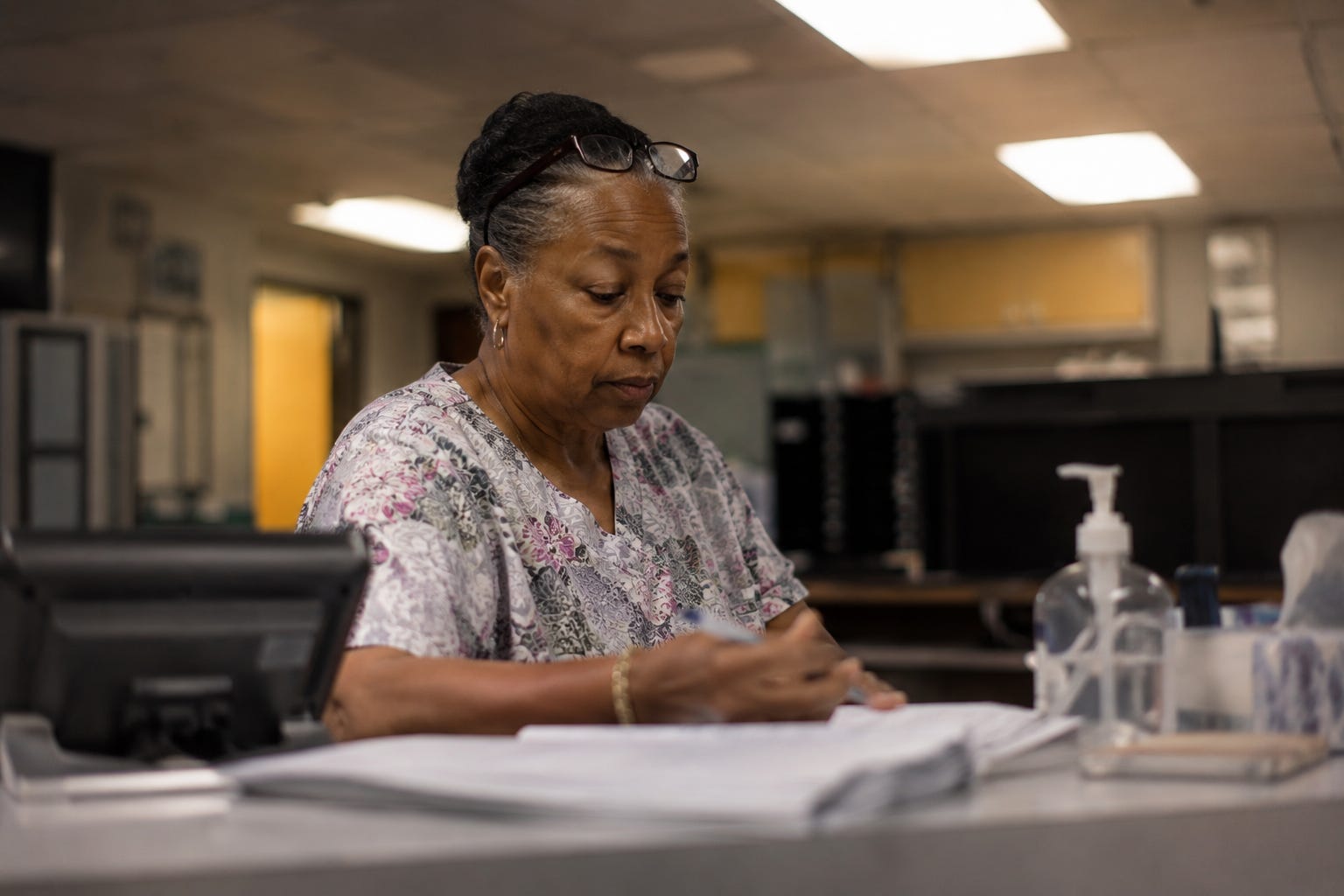
Not every grandparent in this position is old enough to be near retirement at all, and that comes with its own cruelty. Cathy Callahan, a peer counselor in Auburn, Washington, has adopted two of her grandchildren, ages five and fourteen, after one daughter died and another was incarcerated. She is sixty-five. She would like to retire. She cannot.
It is not the paycheck alone holding her in place, though that matters too. It is the health insurance. Both grandchildren have complex medical needs, and Callahan’s job is what keeps them covered. “I hadn’t planned on working this long,” she said, “but things change.”
Sit with what that means. A woman who has already raised one generation is being asked by circumstance to keep showing up to a job past the point she wanted to stop, not for herself, but because the alternative is her grandchildren losing medical coverage. The state did not write that requirement into any statute. It simply built a system where leaving work means losing care, and trusted that grandparents like Callahan would keep working rather than let that happen. Most of them do.
What happens when the foundation shifts under her too
Here is where this piece becomes part of the series rather than a departure from it. Tarrant and Callahan are not relying on Social Security instead of the other programs this series has covered. They are relying on it alongside them, the way most kinship grandparents do. Just over half of grandparent caregivers are employed at all; the rest lean on a mix of fixed income, public health coverage, and whatever Social Security sends, often for grandchildren who are also on Medicaid, also receiving SNAP, also navigating a kinship-care system that, as the last installment in this series showed, frequently pays a relative less than a stranger to do the identical work.
That stack is precarious even when every program holds steady. It is not holding steady.
The Social Security trustees’ 2026 report projects the combined trust funds will be depleted in 2034, with the retirement fund projected to run out a year sooner, in 2032. Part of why is policy already enacted: last year’s reconciliation law reduced the tax revenue flowing into Social Security and Medicare’s hospital trust fund by raising the standard deduction for seniors, a change that delivers little to lower-income beneficiaries while quietly draining the fund those same beneficiaries depend on. If the shortfall is not addressed, the law requires automatic, across-the-board benefit cuts when the trust fund runs dry, falling hardest on retirees, people with disabilities, and survivors with low incomes. That last category has a name in this piece. It is a sixteen-year-old and a set of twelve-year-old twins, drawing survivor benefits because their mother died, in a household already stretched thin.
Meanwhile the same reconciliation law is layering new conditions onto the program these grandparents are also leaning on. Medicaid recipients now face work requirements states must implement by 2027, eighty hours a month of employment, training, or qualifying activity to keep coverage. Caregivers of children thirteen and under are supposed to be exempt. But exemption is not automatic. It is something a grandmother has to prove, to a state bureaucracy, on a timeline, the same paperwork wall this series has already documented swallowing foster youth and kinship caregivers whole.

A grandmother who is also working to keep her grandchild’s insurance, the way Cathy Callahan is, now has two systems simultaneously asking her to document that her caregiving counts.
Three public systems are leaning on the same woman, and two of them are being tightened at the very moment her need for all three is growing.
Why this is not a new fight
It would be easy to read this and assume the series has wandered into territory it does not normally claim. It has not. Nothing about Tarrant’s house requires taking a side on how Social Security should be reformed in the abstract, on tax caps or retirement ages or formulas. The argument here is the one this series has made four times now: when government lets a public obligation go unmet, it does not disappear. It moves to whoever is standing closest, and asks them to absorb it quietly, on top of everything they are already absorbing.
This is not a new fight. It is the same fight, followed all the way down to where it lands hardest: on the people every other system quietly assumes will be there to catch everyone else.
For most families, that obligation moves to one program at a time. For a kinship grandmother, it moves to all of them at once, because she is, structurally, the place several systems have already decided to lean. She is the one absorbing a child welfare system that pays her less than a stranger. She is the one absorbing a long-term care system that was never adequately built to send enough help. And she is the one whose own retirement, the program she spent a working life paying into, is now being asked to stretch around a second household it was never sized for, at the exact moment its own foundation is cracking.
What it means when the floor itself is asked to give
Go back, one more time, to the question this whole series keeps asking. Who is forced to carry what government refuses to hold?
Usually the answer is a person standing outside the system, catching what falls from above. Tarrant and Callahan are something else. They are inside three systems at once, kinship care, Medicaid, and Social Security, each one counting on the others to cover what it does not, each one trusting that she will not let her grandchildren fall through the gap between them. She has not. She is sixty-one, and tired, and still doing the math every month.
A nation can ask one program to stretch further than it was built to stretch and call it resilience. It cannot ask every program to stretch at once, onto the same woman, in the same decade, and still call the arrangement a safety net.
It is not a floor underneath her. It is a net she is barely holding up.
Part of an ongoing series, How a Nation Outsources Its Conscience. Other installments:
- How a Nation Outsources Its Conscience (the flagship essay),
Coming Next:
- Same Child, Different Check (foster and kinship care),
- The Family Caught the Weight (disability and aging).