
The Two-Tiered Tax Code:
Who Washington Really Works For — And Who It Leaves Behind

Tax Justice & Economic Equality
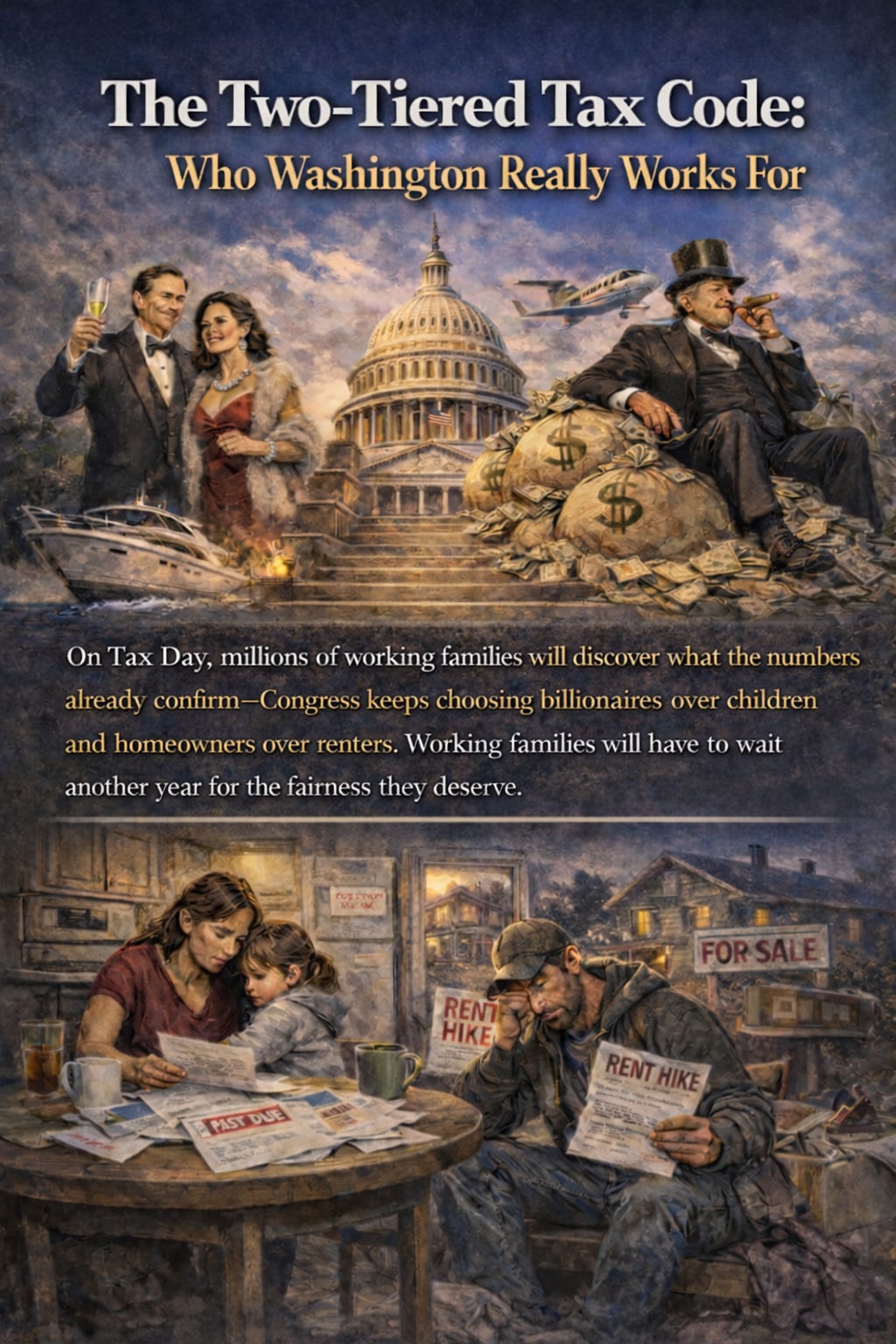
“On Tax Credit Day, millions of working families will discover what the numbers already confirm — Congress keeps choosing billionaires over children, and renters over homeowners will have to wait another year for fairness they were promised.”
Today is Tax Day — but for millions of American families, it is also something more specific: a reckoning. Today is when they learn whether the government that taxes their wages actually sees them. For a single mother working a home health aide job, a family of four renting an apartment in a city they can barely afford, or a child born into poverty through no fault of their own, the tax code is not an abstraction. It is the difference between groceries and hunger, between stability and eviction.
The Child Tax Credit, the Earned Income Tax Credit, and proposed measures like a federal Renters Tax Credit are not giveaways. They are investments — policy tools with proven track records of lifting American families out of poverty. But lawmakers in Washington have repeatedly chosen to protect and expand the wealth of the already-wealthy while leaving the most vulnerable Americans behind. The numbers are damning, and the record is clear.
The Child Tax Credit: A proven weapon against child poverty
The data does not lie. When policymakers actually commit to the Child Tax Credit — fully, for all children — it works. During the pandemic-era expansion under the American Rescue Plan Act in 2021, child poverty fell by a staggering 46 percent, dropping from 9.7 percent to just 5.2 percent, the lowest level ever recorded. Black child poverty fell by 8.8 percentage points in a single year. Hispanic child poverty fell by 6.3 points in that same year. These were not accidents of circumstance. They were the direct result of a policy choice that said every child deserves support regardless of how much their parents earn.
Source: U.S. Census Bureau, Supplemental Poverty Measure, September 2022
That expansion expired. Child poverty spiked by 5 million in 2022. And Congress — the same Congress that found trillions of dollars for tax cuts aimed at the wealthy — has consistently failed to restore what was proven to work.
"Allowing child poverty to exist is a policy choice. So is investing in solutions. The question is not whether we can afford to help children — it is whether we are willing to."
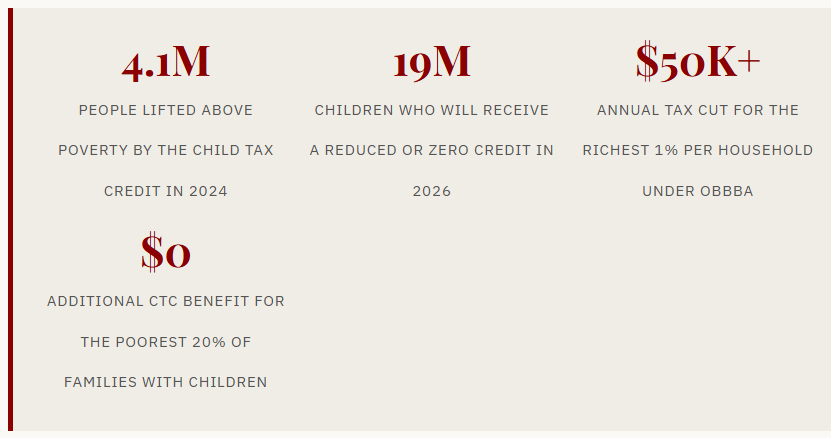
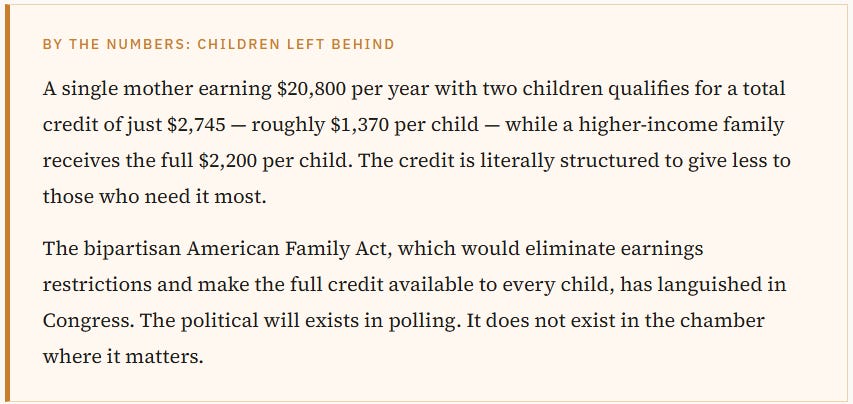
Today, the credit is worth up to $2,200 per child — a modest increase from $2,000 under the recently signed One Big Beautiful Bill Act (OBBBA). But the structural problem remains untouched. The refundable portion of the credit, which is the only part that helps low-income families, is capped at $1,700 per child and subject to earnings restrictions that systematically exclude the poorest households. The result: the richest 20 percent of Americans received the largest benefit from the OBBBA’s credit changes, while the poorest 20 percent received nothing.
Source: Institute on Taxation and Economic Policy (ITEP), March 2026
One in four children under 17 will receive less than the full credit or no credit at all in 2026. Half of all Black children and more than one in three Latino children are among those left behind — a statistical truth that cannot be separated from a long history of discrimination and wage suppression in low-paying work.
A tale of two tax bills: Billions for billionaires, crumbs for children
While working families scrape for every dollar of refundable credit, the One Big Beautiful Bill Act delivered extraordinary wealth to those who needed it least. The nonpartisan Congressional Budget Office estimates the law will cut taxes for the richest 10 percent of Americans by more than $14,700 per year per household. For the richest 1 percent, the annual tax cut exceeds $50,000 per household. Over ten years, the wealthiest 1 percent are slated to pay at least a trillion dollars less in taxes.
Source: Center for American Progress, December 2025; ITEP, April 2026
The OBBBA’s tax provisions cost approximately $4.5 trillion over the next decade. Four corporations — Amazon, Alphabet, Meta, and Tesla — whose chief executives stood beside the president at his inauguration collectively received $51 billion in federal tax breaks in 2025 alone, paying an effective tax rate of just 4.9 percent. At least 88 of the largest corporations in America paid zero federal income tax for 2025. Nvidia, which reported U.S. pretax income of $123 billion — among the greatest earnings growth in corporate history — avoided $6.8 billion in federal income taxes.
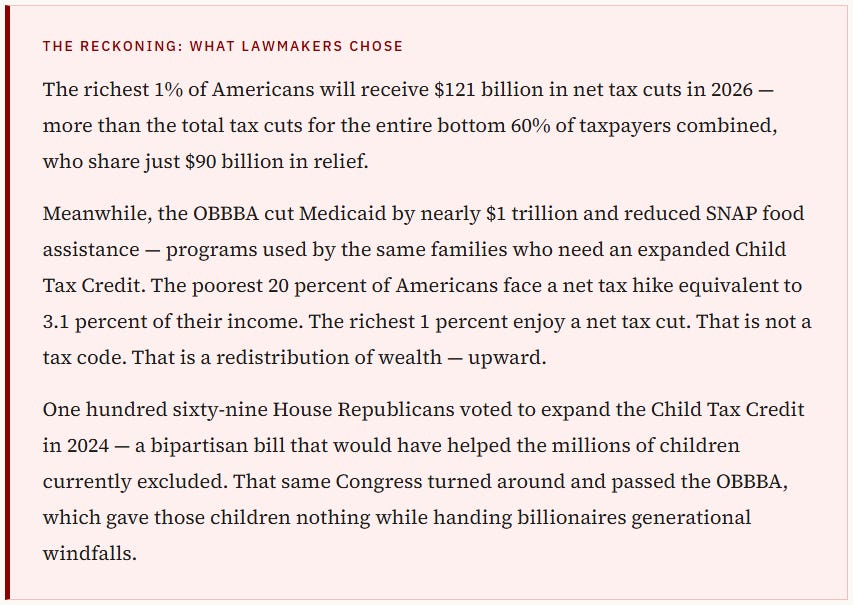
The estate tax exemption was raised to $15 million per person, permanently. The pass-through business deduction — 87 percent of which benefits the top 10 percent of earners — was made permanent. Capital gains protections were expanded for wealthy investors. Foreign investors in U.S. corporations will save $32 billion in taxes in 2026 — more than twice what the bottom 20 percent of American families will receive.
Let that sink in. Foreign shareholders of American companies got a better deal from this Congress than America’s poorest children.
The renters left out of the American Dream
The injustice of the tax code does not stop with child credits. It runs through every aspect of how Washington taxes housing — or rather, who it protects.
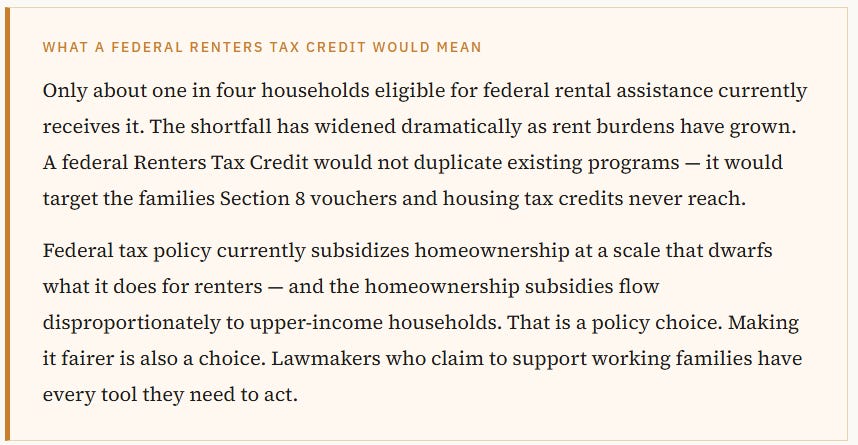
The federal government spends hundreds of billions of dollars subsidizing homeownership: the mortgage interest deduction, the capital gains exclusion on home sales, and property tax deductions overwhelmingly benefit higher-income households. Renters — who make up one in three American households, and who are disproportionately Black, Latino, young, and lower-income — receive almost nothing in comparable federal tax relief.
A federal Renters Tax Credit has been proposed by housing policy experts for years. The model is straightforward: authorize states to allocate federal tax credits so that assisted families pay no more than 30 percent of their income on rent. At a modest $5 billion cap, such a program could help 1.2 million families afford housing, reduce average rents by $400 per month, and lift four out of five of the poorest assisted families out of deep poverty.
Source: Center on Budget and Policy Priorities
Several states — Minnesota, Colorado, California — have taken up their own versions of renters’ credits, recognizing what the federal government refuses to acknowledge: that housing cost burden is one of the most powerful drivers of poverty in America, and that tax policy can address it. Minnesota’s proposed expansion would lift income eligibility thresholds and increase maximum credits to achieve parity with existing homeowner relief. These are reasonable, tested ideas. They are not radical.
The moral test of a tax code
A tax code is a moral document. It reflects what a society values and who its government is willing to fight for. Every April 15, working families file their returns and find out whose side the government is on.
The evidence assembled here is not partisan. It comes from the Congressional Budget Office, the Institute on Taxation and Economic Policy, the Center on Budget and Policy Priorities, Brookings, and the U.S. Census Bureau. These are not activist organizations. They are the institutions we rely on to tell us the truth about what our laws do to real people.
What the numbers show is this: Congress has chosen, repeatedly and with full knowledge of the consequences, to give more to those who have the most and less to those who have the least. They have watched child poverty fall dramatically when the full Child Tax Credit was enacted, and then let it expire. They have heard the arguments for a Renters Tax Credit and looked the other way. They have passed, with little hesitation, $4.5 trillion in tax relief weighted toward the wealthy — and called it beautiful.
Children are not born into poverty because they lack ambition or because their parents made bad choices. They are born into poverty because the systems around them — including the tax code — are designed to keep wealth concentrated and scarcity dispersed. Tax credits like the Child Tax Credit and EITC are among the most efficient, evidence-based, politically achievable tools we have to interrupt that cycle. Their opponents in Congress do not lack the evidence. They lack the will.
"The question is not whether we can afford to lift children out of poverty. The question is whether those in power are willing to choose families over donors, renters over landlords, and children over capital gains.”
On this Tax Credit Day, as millions of families wait on refunds that will cover a month of groceries or a car repair or a child’s medicine, the contrast could not be sharper. While the wealthiest Americans count windfalls measured in tens of thousands of dollars, a home health aide raising two children on $20,000 a year gets a child tax credit worth less than half what a family earning ten times as much receives.
That is not a flaw in the system. It is the system. And the lawmakers who designed it, voted for it, and defended it deserve to be held accountable for every child it leaves behind.
Sources:
U.S. Census Bureau — Record Drop in Child Poverty https://www.census.gov/library/stories/2022/09/record-drop-in-child-poverty.html
ITEP — The Child Tax Credit Leaves Out Millions of Children in 2026 https://itep.org/child-tax-credit-2026-obbba-trump-taxes/
CBPP — The Child Tax Credit https://www.cbpp.org/research/policy-basics-the-child-tax-credit
CBPP — About 16 Million Children in Low-Income Families Would Gain https://www.cbpp.org/research/federal-tax/about-16-million-children-in-low-income-families-would-gain-in-first-year-of
Center for American Progress — 7 Ways the Big Beautiful Bill Cuts Taxes for the Rich https://www.americanprogress.org/article/7-ways-the-big-beautiful-bill-cuts-taxes-for-the-rich/
ITEP — Year One of Trump-Republican Tax Policy https://itep.org/year-one-of-trump-republican-tax-policy-consequences/
ITEP — State-by-State Estimates: All But the Richest Americans Face Higher Taxes https://itep.org/trump-obbba-taxes-lower-for-the-rich-tariffs/
Colorado Fiscal Institute — One Big Beautiful Betrayal https://coloradofiscal.org/one-big-beautiful-betrayal/
Fiscal Policy Institute — New York’s Millionaires Will Get a $12 Billion Federal Tax Cut https://fiscalpolicy.org/new-yorks-millionaires-will-get-a-12-billion-federal-tax-cut-next-year
Wikipedia — One Big Beautiful Bill Act https://en.wikipedia.org/wiki/One_Big_Beautiful_Bill_Act
CBPP — New Federal Renters’ Credit Proposal https://www.cbpp.org/new-federal-renters-credit-proposal
Minnesota House of Representatives — Tax Committee Considers Expanded Renter’s Credit https://www.house.mn.gov/sessiondaily/Story/18655
Brookings — Pathways to Reduce Child Poverty https://www.brookings.edu/articles/pathways-to-reduce-child-poverty-impacts-of-federal-tax-credits/
CBPP — Renters’ Credit Topic Page https://www.cbpp.org/topics/renters-credit